


Bay Area Subdistrict Map · Pasay and Parañaque, Metro Manila
A District That Didn't Exist 20 Years Ago
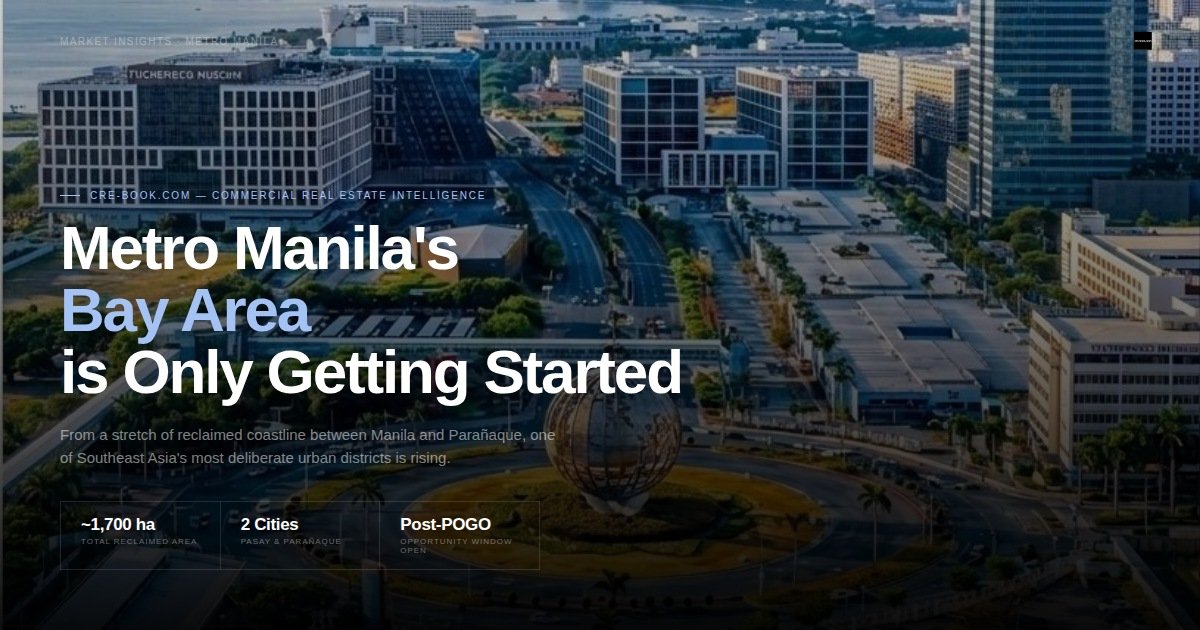
Stand at the edge of Roxas Boulevard today and look south. What you see, the gleaming casino resorts, the grid of wide roads, the towers still going up along the waterfront, was ocean floor not long ago. The Bay Area, broadly defined as the reclaimed coastline stretching from Manila's harbor all the way south through Pasay and into Parañaque, is one of Metro Manila's youngest districts and, by most measures, its most intentionally designed.
Compare that to Makati's CBD, which evolved organically from the Ayala estate over five decades, or to BGC, which began its transformation in the 1990s. The Bay Area is, in historical terms, a toddler. But it is a very well-planned toddler, and the commercial real estate market is starting to pay serious attention.
"The Bay Area is one of the few places in Metro Manila where you're not retrofitting infrastructure into existing urban fabric. You're laying it down clean, from the grid up."
Bay Area: Planning AdvantageWhere Exactly Is "The Bay Area"?
The term "Bay Area" in Philippine real estate refers loosely to the reclaimed waterfront zone along Manila Bay, but it helps to understand its three distinct clusters. Bay City, anchored by SM Mall of Asia, is the northernmost anchor and the most mature, already a functioning mixed-use district with the eCom Office Buildings, Met Park, and DoubleDragon Plaza forming its office core. Moving south along the President Diosdado Macapagal Boulevard, you pass through Aseana City in Parañaque, where office parks, logistics hubs, and residential towers continue to rise. Further south still lies Entertainment City, the PAGCOR-licensed gaming and resort zone that serves as the corridor's southernmost anchor, home to Solaire, Okada Manila, and Resorts World Manila.
Together, these sub-districts form a coherent corridor, a linear CBD that runs parallel to the bay. Unlike Makati or BGC, it is not a grid of a few city blocks. It is a district-scaled zone, and its development story is still being written.
Why It's Younger Than You Think

Most of what defines the Bay Area commercially opened after 2010. SM Mall of Asia launched in 2006 and at the time it was essentially surrounded by undeveloped reclaimed land. Solaire Resort opened in 2013. Okada Manila opened in 2016. The bulk of the office and residential towers in Aseana followed in the mid-2010s and are still being completed in some phases today.
This is critical context for commercial real estate decisions. Other Metro Manila CBDs such as Makati, Ortigas, and BGC carry decades of accumulated urban density, established communities, and, inevitably, congested infrastructure. The Bay Area does not yet have that density, but it also does not have those constraints. Its roads were planned for the scale they need to serve. Its utilities were laid with modern specifications. Its building setbacks, underground cabling, and pedestrian infrastructure were designed for a city that had not yet arrived.
How the Bay Area Came to Be
Reclamation Begins
The Public Estates Authority begins systematic land reclamation along Manila Bay. The primary goal is to address Metro Manila's land scarcity and create government-controlled developable land. Much of what is now Bay City and Entertainment City is ocean at this stage.
SM Mall of Asia Opens — The First Anchor
SM Prime opens Mall of Asia on reclaimed land in Bay City, Pasay. It signals that the reclaimed area is viable for large-scale commercial development and begins attracting investor attention to the corridor.
PAGCOR's Entertainment City Mandate
PAGCOR designates a strip of reclaimed land in Parañaque as "Entertainment City," a licensed zone for integrated resorts. Land parcels are allocated to major casino operators, setting the foundations for the Bay Area's most high-profile subdistrict.
The Big Openings: Solaire, City of Dreams, Okada
Solaire Resort & Casino (2013), City of Dreams Manila (2014–2015), and Okada Manila (2016) all open in quick succession. The Bay Area becomes internationally recognized as a hospitality and gaming destination, and ancillary commercial development accelerates.
The Office Districts Take Shape Across the Corridor
The Bay Area's office market develops across multiple distinct clusters. On the Pasay side, the eCom Office Buildings within the Mall of Asia Complex become a premier BPO address, while Met Park and DoubleDragon Plaza add significant Grade A supply. On the Parañaque side, Aseana Business Park rounds out the corridor as the southernmost office hub, sitting closest to NAIA. Then POGO locators arrive and redefine the pace entirely — at the height of the boom, whole buildings are absorbed almost instantaneously.
Continued Reclamation & Vertical Growth
Despite pandemic-era slowdowns, the Bay Area's pipeline remains active. New residential towers, additional office phases, and ongoing reclamation projects expand the footprint further. The district enters a new phase, filling in the gaps between its anchors.
The Infrastructure Advantage
Ask any CRE professional why they recommend the Bay Area to certain clients, and infrastructure comes up almost immediately. This is not an accident. It is a direct consequence of being planned on blank reclaimed land rather than built atop a pre-existing city.
The President Diosdado Macapagal Boulevard, the Bay Area's main spine, is an eight-lane arterial road with wide sidewalks, underground utilities, and relatively few of the signal intersection bottlenecks that make Ayala Avenue or EDSA so punishing. It connects Bay City in the north directly through Entertainment City and into Aseana in the south, giving tenants and logistics operators a rare commodity in Metro Manila: predictable travel times.
NAIA proximity is perhaps the Bay Area's most undersold advantage. Terminals 1, 2, and 3 are all within 10 to 15 minutes from the center of Entertainment City and Aseana, making the corridor exceptionally attractive for hospitality, aviation services, logistics, and any business requiring frequent international travel. No other CBD in Metro Manila can make this claim.
In terms of overall accessibility, the Bay Area now sits alongside Makati as one of only two Metro Manila CBDs that check every box. Both districts have direct expressway access via NAIAX, main road links through EDSA, Roxas Boulevard, and Coastal Road, and now a train connection through the LRT-1 network. Among all of Metro Manila's business districts, only Makati and the Bay Area offer that full combination. For tenants evaluating where to locate, that convergence of access modes is no longer a differentiator for Makati alone.
Rail connectivity, historically the district's weak point, is now actively changing the conversation. The LRT-1 Cavite Extension, which runs southward along the bay corridor, is drawing immediate attention from office tenants and developers who had previously cited public transport as a hesitation point. For BPO operators evaluating the Bay Area against Ortigas or Alabang, a functioning rail line removes one of the last remaining objections. The workforce catchment now extends deep into Parañaque, Las Piñas, and beyond, a population base that was previously difficult to reach without a car.
Built for the City It's Becoming
The Bay Area's infrastructure edge over older Metro Manila districts is structural: it was designed at scale, not retrofitted.
8-Lane Boulevard Spine
President Diosdado Macapagal Boulevard runs the full length of the district with underground utilities, wide pedestrian lanes, and minimal signal interruption, a rarity in Metro Manila.
NAIA in Under 15 Minutes
All three operational NAIA terminals are within a 10 to 15 minute drive from the core of the Bay Area. No other Metro Manila CBD offers this level of airport proximity.
Rail Connectivity: LRT-1 Extension
The LRT-1 Cavite Extension brings mass transit into the Bay Area corridor, solving the district's historically weak public transport link and widening the accessible workforce catchment significantly.
Flood Mitigation by Design
As reclaimed land, the Bay Area's drainage and flood control infrastructure was engineered from the ground up, unlike older urban areas built on low-lying floodplains without modern stormwater systems.
Underground Utilities
Power, telecoms, and data lines are undergrounded throughout the district, reducing outage risk, improving aesthetics, and making the streetscape significantly more walkable.
Planned Parking Density
Large-format basement and podium parking were incorporated into building designs from the start, unlike retrofitted parking in older districts where supply is perpetually constrained.
Who Is Here and Where
SM Mall of Asia Complex
The district's first and most established anchor. Its commercial reach now includes the SM Mall of Asia Arena, the seaside boardwalk, the eCom Office Buildings, and a growing roster of major global locators. Amazon has established operations here, alongside retail giants IKEA and Shein, signaling the complex's pull as a premier address for international brands.
DoubleDragon Meridian Park
One of the Bay Area's most strategically significant office and mixed-use developments. Logistics giant 2GO anchors its commercial roster, while the complex also hosts key government agencies including the Department of Foreign Affairs (DFA), PEZA, and TIEZA, making it one of the few addresses where logistics, government, and corporate tenants converge.
Aseana City
The largest private mixed-use development in the Bay Area corridor. Even Ayala Land is a locator here, operating Ayala Malls Manila Bay within the estate. Office tenants include CMA CGM Philippines Inc., Ocean Network Express (ONE), and V.Ships Manila, reinforcing Aseana City as the Bay Area's most corporate address.
Entertainment City
The southernmost subdistrict and the Bay Area's most internationally recognized zone. Anchored by Solaire Resort and Casino, which opened in 2013 as the first integrated resort in the zone, followed by City of Dreams Manila and Okada Manila, completing the corridor's transformation into a world-class leisure and MICE destination.
The POGO Boom and What It Left Behind
To understand where the Bay Area's office market stands today, you have to understand what happened between 2016 and 2022. The Philippine Offshore Gaming Operator (POGO) industry, which comprised online gaming companies licensed by PAGCOR and staffed largely by Chinese nationals, descended on Metro Manila's office market with extraordinary speed. The Bay Area, with its wide roads, modern building stock, and proximity to the airport, became one of the industry's favored addresses.
At its peak, POGO operations occupied significant volumes of Bay Area office space, driving rents up and vacancy down. Landlords who had struggled to fill newer towers suddenly had competing inquiries. The district felt like it had arrived ahead of schedule.
Then the industry collapsed. A combination of government crackdowns, PAGCOR policy reversals, and a final ban on POGO operations in 2024 triggered a mass exodus. Tens of thousands of square meters of office space were vacated across the Bay Area in a compressed timeframe, pushing vacancy rates sharply higher.
"The POGO exit was painful in the short term, but it cleared the decks. What's being backfilled now is a fundamentally more stable tenant profile: government agencies, BPOs, maritime companies, and corporate HQs that are here for the long run."
Bay Area Office Market: Post-POGO RecoveryRecovery is already underway. The tenant base replacing POGOs is more diverse and more durable, and the district's underlying infrastructure advantage is now driving a more considered wave of relocation decisions.
Government Follows the Infrastructure
One of the clearest signals that the Bay Area has matured as a district is the volume of government agency relocations it has attracted. PAGCOR, the Philippine Amusement and Gaming Corporation, maintains significant operational presence in the Bay Area. The Department of Foreign Affairs (DFA) has a consular office serving the south Metro Manila catchment. TIEZA, the Tourism Infrastructure and Enterprise Zone Authority, is also present in the zone, consistent with its mandate to develop tourism enterprise zones along the bay area corridor.
Other government-linked entities operating in or adjacent to the corridor include the Philippine Reclamation Authority and various DPWH and BCDA-affiliated offices tied to ongoing infrastructure programs in the district. Government clustering matters because it stabilizes a district, brings footfall, and signals to private sector tenants that the area has long-term institutional backing.
Old Manila's Maritime Industry Is Moving South
The Bay Area offers something old Manila can no longer provide: modern office specifications at competitive rents, with far better road access for staff coming from the south, direct visibility to the bay, and critically, proximity to the NAIA terminals that crew change operations depend on.
The names making this move speak to the sector's breadth. Odfjell Shipping, Ocean Network Express (ONE), and V.Ships are among the established maritime operators that have established presence in the Bay Area corridor, joined most recently by Intership Manning Agency. These are not small back-office relocations. These are recognized names in international shipping and ship management, and their choice of the Bay Area over old Manila is a clear signal of where the industry is heading.
For landlords and property managers, this sector represents a particularly stable tenant class. Manning agencies operate on multi-year contracts with international shipping principals, carry regulatory requirements that make frequent moves impractical, and tend to lease on long terms.
What This Means for Commercial Real Estate
For property seekers and CRE professionals, the Bay Area presents a proposition that is genuinely distinct from other Metro Manila districts. It is not trying to be Makati. It is not trying to be BGC. It is something different: a waterfront district with an entertainment-anchored economy, outstanding airport access, and infrastructure that was never compromised by the organic sprawl that characterizes older CBDs. The elevated vacancy left by the POGO exodus has, if anything, made the entry point more attractive, with landlords offering terms that were not on the table two years ago, and a tenant mix that is now anchored by government agencies, maritime firms, and established BPOs rather than a single volatile industry.
Office rents in the Bay Area corridor typically sit below BGC and Makati Grade A benchmarks, which means that for companies where NAIA access and wide-road logistics matter more than an Ayala Avenue address, the value proposition is compelling. The BPO sector has been leasing heavily in Aseana and adjacent sub-districts, and the hospitality sector has effectively made Entertainment City a recognized international destination.
"The Bay Area was stress-tested by the POGO collapse and it passed. The infrastructure held, the government anchors stayed, and a more durable tenant base moved in. That is not a district in decline. That is a district finding its floor."
Bay Area Office Market: Recovery & OpportunityThe Bottom Line
Every great business district has a moment when it stops being a speculation and starts being a fact. BGC had that moment sometime around 2010. The Bay Area is in the middle of its own version of that inflection now, still young enough to have land, still new enough to have modern infrastructure, but mature enough that the anchors are real, the roads are built, and the trajectory is clear.
For anyone making commercial real estate decisions in Metro Manila, the Bay Area is no longer optional to understand. It is one of the city's defining districts, and it is only getting started.
Find Bay Area Properties on

#1 Commercial Real Estate Marketplace Platform & Work Tool in the Philippines
Explore Listings →
Join The Discussion