

One Hour a Week, Across 350 Properties
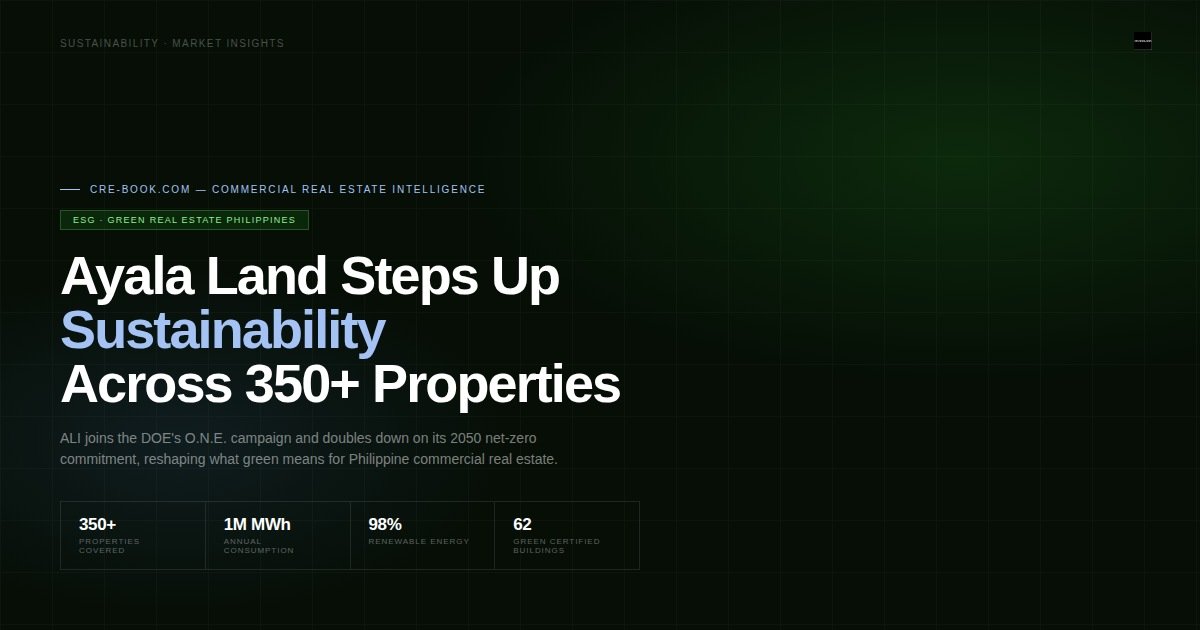
Ayala Land Inc. (ALI) is bringing its full portfolio weight to the country's energy conservation push. In a collaborative effort with the Department of Energy (DOE), the Zobel-led property giant has enrolled more than 350 of its developments nationwide into the government's newly launched O.N.E. (Oras Natin sa Efficiency) campaign, a nationwide demand-side management strategy that challenges households, businesses, and public institutions to cut electricity consumption for one hour every week.
For a portfolio the size of ALI's, which collectively consumes roughly one million megawatt-hours of electricity annually, participation is not symbolic. It is a measurable, operational commitment that requires coordinated scheduling across malls, offices, hotels, logistics facilities, and residential communities spread across the entire country.
How the One-Hour Savings Window Works
To implement the weekly conservation window across its diverse property segments, ALI has established staggered schedules by asset type. Critically, the company has clarified that power reductions will target nonessential lighting and equipment only, with critical safety, security, and emergency lighting remaining fully operational throughout.
Weekly Energy Conservation by Asset Type
Staggered across property segments to minimize operational disruption while maximizing portfolio-wide impact.
Deepening the Green Blueprint
Management has been clear that the O.N.E. initiative is not a standalone gesture. It reinforces energy conservation programs that are already embedded in ALI's daily operations, and it sits within a much broader sustainability framework that the company has been building for years.
Ayala Land has committed to a target of net-zero greenhouse gas emissions by 2050, a goal formally validated by the Science Based Targets initiative (SBTi), one of the most rigorous third-party sustainability benchmarks available. SBTi validation means ALI's emissions reduction pathway has been independently verified as consistent with limiting global warming to 1.5°C, which places it among a small group of Philippine companies operating at international ESG standards.
"Rather than treating sustainability as a series of isolated pilots, the developer focuses on energy-efficient architectural designs, operational adjustments, and proactive transitions to clean power sources."
Ayala Land Inc., Sustainability StrategyToday, 98 percent of the company's commercial portfolio operates on renewable energy or is offset through verified renewable energy certificates. For tenants occupying ALI properties, this translates directly into lower Scope 3 emissions reporting, a metric that is increasingly material for multinational companies with their own ESG commitments and sustainability reporting requirements.
The Scale of ALI's Green Infrastructure
Numbers that put ALI's sustainability commitment in operational context.
Installed Rooftop Solar
Current installed capacity across 13 Ayala Malls, with expansion planned to 38.4 MW total pipeline by 2027.
EV Charging Stations
Electric vehicle charging infrastructure deployed across 64 ALI properties nationwide, supporting the green transport transition.
Green Certified Buildings
Developments spanning 2.7 million square meters of gross floor area certified under LEED, WELL, and IFC EDGE standards.
Solar Pipeline by 2027
Planned total rooftop solar capacity expansion from 15.3 MW today to 38.4 MW by 2027, more than doubling current installed capacity.
LEED, WELL, and IFC EDGE, What They Mean for Tenants
ALI's 62 certified buildings span three internationally recognized green building standards, each measuring different dimensions of sustainability performance.
Leadership in Energy and Environmental Design
The world's most widely used green building rating system, covering energy efficiency, water use, indoor air quality, and sustainable materials. LEED certification is the most common prerequisite for multinational tenants with global real estate standards.
WELL Building Standard
Focuses specifically on human health and wellness within the built environment, covering air, water, nourishment, light, movement, thermal comfort, sound, and mind. Increasingly required by companies prioritizing employee wellbeing in their real estate decisions.
IFC Excellence in Design for Greater Efficiencies
An International Finance Corporation standard designed for emerging markets, measuring efficiency improvements in energy, water, and embodied energy in materials. EDGE certification is particularly relevant for cost-sensitive tenants seeking verified green credentials without LEED-level investment.
Why This Matters for Commercial Real Estate Tenants
ALI's sustainability scaling has direct implications for companies evaluating office and commercial space in the Philippines. As ESG reporting requirements tighten globally, driven by SEC disclosure rules, investor pressure, and supply chain due diligence requirements from international clients, the building a company occupies has become a material factor in its own sustainability profile.
Occupying a LEED or WELL certified ALI property contributes directly to a tenant's Scope 3 emissions reporting. The 98 percent renewable energy coverage across the commercial portfolio means that electricity consumed in an ALI office is largely decarbonized, which can meaningfully reduce a company's operational carbon footprint without any additional effort on the tenant's part.
For multinational companies, law firms, financial institutions, and BPO operators with global sustainability commitments, this is no longer a preference. It is increasingly a procurement standard. ALI's portfolio, with its breadth of certified buildings, solar infrastructure, and SBTi-validated net-zero pathway, positions it as the clearest answer to that requirement in the Philippine market.
The O.N.E. Campaign in Broader Context
The DOE's O.N.E. (Oras Natin sa Efficiency) campaign is a demand-side management strategy aimed at reducing strain on the Philippine power grid during peak demand periods. By recruiting large-scale commercial participants like ALI, the government is acknowledging that meaningful grid relief requires institutional participation, not just household behavior change.
For a portfolio that consumes approximately one million megawatt-hours annually, even a one-hour weekly reduction across 350 properties represents a measurable contribution to national grid stability. It also signals to the broader real estate sector that sustainability and operational responsibility are not at odds with commercial performance, a message that carries weight at ALI's scale and visibility.
Explore LEED/WELL and other commercial properties with sustainable certifications on

#1 Commercial Real Estate Marketplace Platform & Work Tool in the Philippines
Explore Listings →
Join The Discussion