

ASEAN 2026 Concluded: What It Will Bring To Philippine Commercial Real Estate
The Philippines closed its chairmanship with a regional digital trade pact, two superpowers at the same table, and a contested US-led tech hub on its doorstep. Here is what it means for office and industrial real estate.
- ASEAN 2026
- Pax Silica
- Philippine Economy
- Office Demand
The 49th ASEAN Summit and Related Summits wrapped up at the PICC in Pasay on November 17, ending the Philippines' year as chair under the theme "Navigating Our Future, Together." President Marcos handed the gavel to Singapore's Prime Minister Lawrence Wong, who chairs in 2027.
For commercial real estate, summits matter less for the speeches than for what they signal to capital: where trade rules are heading, which partners are committing, and how stable the operating environment looks. On those counts, Manila delivered more than skeptics expected and less than the headlines suggest.
The Philippines showed it can run a complex, high-security diplomatic calendar while engaging both Washington and Beijing. The clearest economic win is the ASEAN Digital Economy Framework Agreement (DEFA), expected to take effect in early 2027, which supports demand for digital services and the offices that house them. The biggest swing factor is Pax Silica: unsigned, contested, and potentially transformative for Central Luzon if it proceeds.
Key facts
| Summit dates | November 15 to 17, 2026, PICC, Pasay City |
|---|---|
| Chair theme | Navigating Our Future, Together |
| Headline agreement | ASEAN Digital Economy Framework Agreement (DEFA), signed November 14 by all 11 member states |
| Other outcomes | Declarations on critical minerals and strategic trade management, progress on the ASEAN Power Grid, and adoption of the concept note for an ASEAN Maritime Center to be hosted in the Philippines |
| Unfinished | The South China Sea Code of Conduct, targeted for 2026, was not concluded |
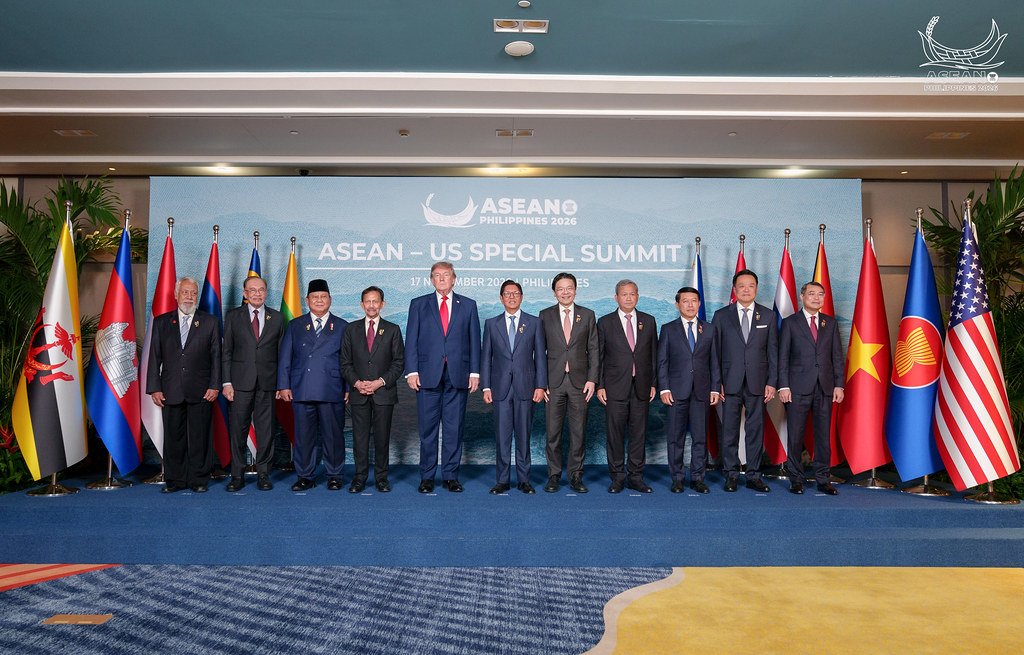
| US engagement | President Trump in Manila November 17 to 18: ASEAN-US Special Summit, Quad leaders' meeting, bilateral with President Marcos |
| China engagement | Marcos and Premier Li Qiang co-chaired the 29th ASEAN-China Summit on November 16 |
| 2027 chair | Singapore |
What Manila delivered
The signature result is DEFA, which sets common regional rules for digital trade, cross-border data flows, electronic payments, and cybersecurity. Marcos described it as the first region-wide digital framework of its kind. ASEAN's stated goal is to roughly double the region's digital economy to US$2 trillion by 2030.
Beyond digital trade, leaders adopted declarations on critical minerals and strategic trade management and advanced the ASEAN Power Grid. The foreign ministers adopted the concept note and terms of reference for an ASEAN Maritime Center to be based in the Philippines. Trade talks also moved with outside partners: South Korea launched negotiations to upgrade its ASEAN free trade agreement, and Canada and the Philippines announced the conclusion of a bilateral FTA they aim to sign next year.
Analyst Rommel Banlaoi, writing in Eurasia Review, called the chairmanship productive while cautioning that it should be read with neither triumphalism nor pessimism. That is a fair frame. The logistics, security, and diplomatic choreography of hosting 11 member states and their dialogue partners, including a US presidential visit, were executed without major disruption to the summit program.
Philippines between China and the USTwo superpowers, one host
The week showed Manila working both relationships at once.
China
At the 29th ASEAN-China Summit, Marcos and Premier Li Qiang reaffirmed commitments to deeper ASEAN-China ties, marking 35 years of dialogue relations. Li cited ASEAN-China trade above US$1 trillion last year. The talks covered supply chains, MSMEs, science and technology, and AI. After the summit, the Philippines reported P41.1 billion in investment pledges from Marcos's trip to China for APEC. The limit was the South China Sea: the Code of Conduct, which ASEAN and China had aimed to finish in 2026, remains open, with members still divided on whether it should be legally binding.
United States
Trump attended the ASEAN-US Special Summit, a Quad leaders' meeting, and a bilateral at Malacañang, where he announced what he called the biggest US trade deal with the Philippines. Neither government released terms. Manila went in seeking tariff relief for Philippine exports. Until the text is public, exporters and ecozone locators cannot price the benefit.
Views on what this balance means differ. The Council on Foreign Relations argued before the summit that Manila was already tilting toward Beijing as US security commitments thinned. Others read the Quad meeting and the US trade announcement as Manila anchoring closer to Washington. A third view, closer to ASEAN's own tradition, sees hedging: securing trade and investment from both while avoiding a binary choice. For investors, the practical reading is the same either way. Both supply chains want a foothold in the Philippines.
Pax Silica protests in the PhilippinesThe Pax Silica debate
Pax Silica is a US-led initiative to build allied supply chains for critical technologies and minerals. Its first planned industrial hub is a roughly 4,000-acre (about 1,620-hectare) site in New Clark City, Capas, Tarlac. Both governments said no agreement would be signed during Trump's visit, and CSIS reported its legal framework is not expected to be signed until year-end.
The project drew sustained protests during the summit week. Students, indigenous groups, and activists marched in Metro Manila and other areas, with walkouts reported in Metro Manila, Baguio, and Central Luzon. Their concerns fall into three groups:
- Land and displacement. Part of the site overlaps with ancestral domain claims of Aeta communities and with farmland in Capas.
- Water and power. Critics question the hub's water and electricity needs, particularly ahead of an expected El Niño.
- Sovereignty and alignment. Some groups argue deeper participation in a US-led technology framework could draw the Philippines further into US-China competition.
Rights groups also raised concerns about how police handled some of the demonstrations.
The government's position, stated by Marcos in Shenzhen on November 20, is that there is nothing yet to oppose: no deal has been signed and no provisions exist. He said no data centers will be built at the site and framed the initiative as the country's chance to take part in the AI economy rather than only adopt technology built elsewhere.
Philippine economy outlook 2027"AI is here and will be here to stay."
President Ferdinand Marcos Jr., Shenzhen, November 20, 2026 (via Philstar)
How this affects the economy and real estate
Office: digital services get a regional rulebook
DEFA lowers friction for cross-border data, payments, and e-commerce. That favors the industries that already fill Metro Manila's offices: IT-BPM, shared services, global capability centers, fintech, and digital platforms. The effect will be gradual since implementation starts in 2027, but it strengthens the case for regional delivery teams in Makati CBD, BGC, Ortigas, and Alabang.
Industrial and Central Luzon: high upside, high uncertainty
If Pax Silica proceeds, Clark and Tarlac would see demand for industrial land, logistics, worker housing, and support offices. New Clark City is already government-planned, which helps. But an unsigned framework, unresolved land claims, and open questions on water and power are exactly the issues that determine whether locators commit. Developers pricing land on Pax Silica today are pricing optionality, not a pipeline.
Trade and export manufacturing
New FTA momentum with Canada and South Korea, plus whatever the US deal contains, broadens market access for ecozone exporters. Tariff relief from the US would matter most for labor-intensive exports. None of this moves until terms are published.
Regional presence and visibility
Hosting the full ASEAN calendar and an ASEAN Maritime Center raises Manila's profile with governments and multinationals scanning the region for representative and regional offices. Profile alone does not sign leases, but it shortens the list of reasons to look elsewhere.
Our Take On This
Manila's chairmanship was a credible showing. The country hosted both the US President and China's Premier in the same week, kept dialogue open with both, and walked away with a signed regional digital framework. For a market that often prices in political risk, that is useful evidence of institutional capacity.
Our view is that the most bankable outcome for real estate is the least dramatic one. DEFA is signed, has a timeline, and maps directly onto the tenant base that already drives Metro Manila office demand. That is where we would expect the earliest effects, in leasing enquiries from digital services and regional delivery teams through 2027.
On Pax Silica, we would treat it as upside rather than base case. The concerns raised by protesters about land, water, and power are not only social issues. They are the same issues lenders, locators, and insurers will scrutinize before committing capital. A project that resolves them transparently and early will be more investable than one that does not, regardless of where one stands on the politics.
The honest downside: much of this week's news is announcement, not contract. The US trade deal has no published terms, Pax Silica has no signed framework, the Code of Conduct remains open, and DEFA's benefits depend on national implementation.
For occupiers
Do not take space on summit headlines. Plan on your own hiring pipeline, and if a 2027 expansion is likely, start the search early: fitout and move-in lead times count from handover of the space, not from lease signing.
For investors
Office landlords and developers: DEFA reinforces the existing tenant base rather than creating a new one. The buildings best placed to benefit are those that already suit digital services and regional delivery teams, with strong connectivity, power redundancy, and floorplates that work for scaling headcount. Upgrading that specification is a lower-risk play than speculative new supply.
Industrial and land in Central Luzon: Underwrite Pax Silica as an option, not as cash flow. Until the framework is signed, value land on demand that exists without it, and stage any commitment to clear milestones: a signed agreement, published terms for locators, and transparent resolution of ancestral domain claims, water supply, and power. Title and land-claim diligence matters more here than usual, because unresolved claims are now a public issue.
Export-linked assets: Ecozone and logistics assets serving US-bound manufacturing carry tariff exposure until the terms of the US trade deal are published. Treat any rerating on the announcement alone as premature.
Geopolitical exposure: Manila is drawing capital from both the US and China. That widens the investor and tenant pool, but supply chain initiatives can come with restrictions on technology partners and sourcing. Know who your tenants' end customers are and keep tenant exposure diversified.
The milestones worth tracking into 2027: the Pax Silica framework signing, the US trade deal terms, DEFA implementation rules, and progress on the Code of Conduct.
FAQ
What did the Philippines achieve as 2026 ASEAN chair?
The main outcomes were the signing of the ASEAN Digital Economy Framework Agreement (DEFA), declarations on critical minerals and strategic trade management, progress on the ASEAN Power Grid, and the adopted concept note for an ASEAN Maritime Center in the Philippines. The South China Sea Code of Conduct was not concluded.
What is DEFA and when does it take effect?
DEFA is a region-wide agreement setting common rules for digital trade, cross-border data flows, e-payments, and cybersecurity. It was signed in Manila on November 14, 2026 and is expected to enter into force in early 2027.
What is Pax Silica and why are people protesting?
Pax Silica is a US-led initiative to build allied supply chains for critical technologies and minerals, with a first hub proposed in New Clark City, Tarlac. Protesters cite displacement of Aeta communities and farmers, water and power use, and concerns about geopolitical alignment. The government says no agreement has been signed and no data centers will be built at the site.
How will the ASEAN Summit affect office demand in Metro Manila?
The most direct link is DEFA, which supports digital services, IT-BPM, and regional delivery teams that already drive office leasing in Makati CBD, BGC, Ortigas, and Alabang. Effects are likely to be gradual from 2027 rather than immediate.
What does the ASEAN Summit mean for real estate investors?
DEFA supports the existing office tenant base, favoring buildings suited to digital services. Pax Silica is upside for Central Luzon land and industrial assets but remains unsigned, so it is best underwritten as an option with commitments tied to clear milestones. Export-linked assets carry tariff exposure until US trade deal terms are published.
Sources
- Banlaoi, R. "ASEAN 2026: A Productive Chairmanship, But The Hard Tests Remain." Eurasia Review, November 19, 2026.
- "President 'perplexed' by protests vs Pax Silica." Inquirer Global Nation, November 2026.
- "PH, China reaffirm vow to deepen Asean ties." Inquirer Global Nation, November 2026.
- "Trump in Manila: Security, tariff issues to be raised." Inquirer Global Nation, November 17, 2026.
- "ASEAN Outcomes and Trump's Manila Visit." CSIS, November 2026.
- "Philippines concludes 2026 ASEAN chairship, hands over leadership to Singapore." Manila Bulletin, November 17, 2026.
Stay Updated with Philippine Commercial Real Estate News
Market insights, policy shifts, and new listings, delivered to your inbox.

Join The Discussion