

Commercial real estate in the Philippines has long operated on a fragmented foundation. Listings are scattered across broker networks, Facebook groups, personal websites, and general property portals — most of which were built with residential real estate in mind. The industry has made do. But making do is not the same as being well-served.
cre-book.com was built with one purpose: to give commercial real estate in the Philippines the dedicated platform it has always needed. This article explains why that distinction matters, and why a purpose-built platform changes how professionals in this industry work.
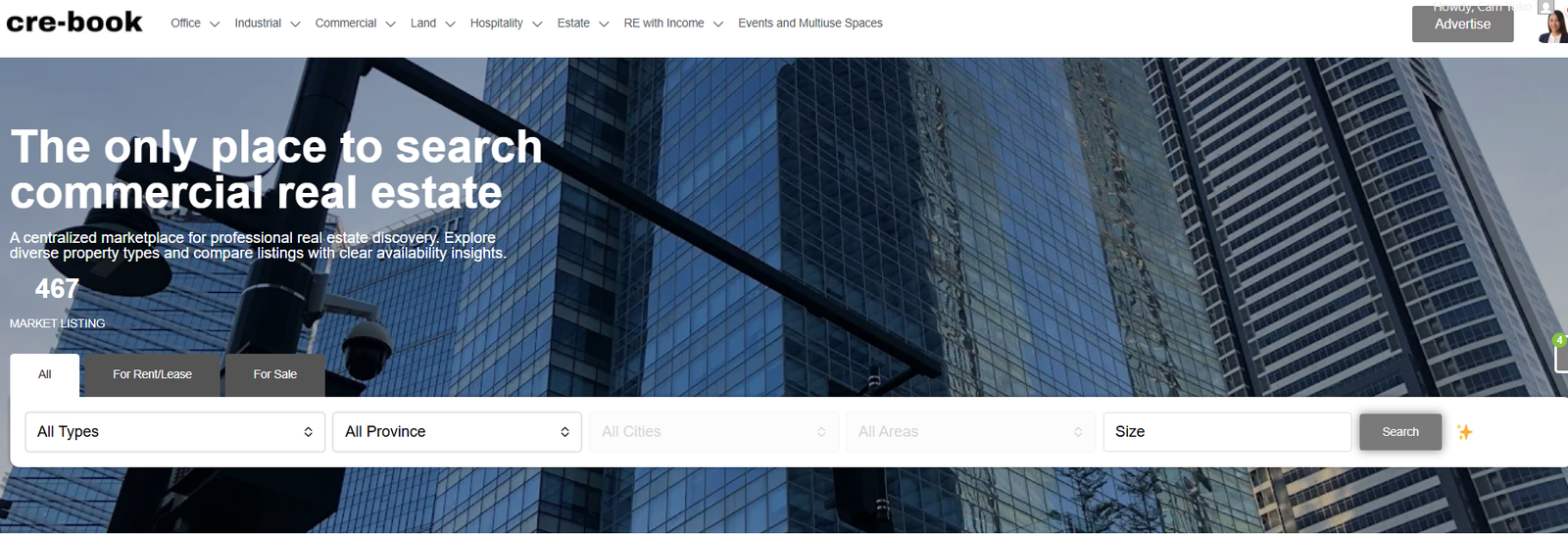
There Is No Dedicated CRE Platform in the Philippines
This is not a gap that has been partially addressed. It is a gap that has not been addressed at all. As of today, there is no platform in the Philippine market built specifically for commercial real estate — one that structures data around commercial property types, serves the professionals who transact in them, and supports the full scope of how CRE deals are found, evaluated, and closed.
What exists instead are residential platforms that have added a commercial tab, generic classifieds that treat a warehouse the same as a studio apartment, and social media marketplaces that offer no structure at all. None of these were designed for commercial real estate.
This is why we built cre-book.com! The industry needs one.
The foundational logic of a residential property platform is organized around what a homebuyer or renter needs: bedrooms, bathrooms, proximity to schools, and price. These are legitimate criteria for that market. They are irrelevant in commercial real estate.
A company looking for office space is asking different questions entirely. How many square meters of net leasable area does the building offer? What is the floor plate configuration? Is the building PEZA-accredited? Does it have redundant power systems and multi-telco infrastructure? Is 24/7 operations permitted? What is the parking allocation ratio?
None of these fields exist in a meaningful way on platforms built for residential search. The result is that commercial property finders are forced to work with incomplete data, contact brokers for basic specifications, and manually verify information that should be available upfront. This slows every stage of the process.
Commercial Real Estate Has Its Own Variants — Each With Different Requirements
Even within commercial real estate, property types are not interchangeable. An office building and an industrial facility are both commercial assets, but the information required to evaluate them is entirely different.
Consider the range of asset types:
- Offices — evaluated by grade, floor plate, building systems, PEZA status, and amenities
- Industrial and warehouse facilities — evaluated by ceiling height, floor load capacity, power load, dock access, and lot area
- Retail and commercial spaces — evaluated by foot traffic, frontage, visibility, tenant mix, and lease flexibility
- Land for development — evaluated by zoning classification, road access, utilities, and proximity to infrastructure
- Hospitality — evaluated by room count, brand standards, operating licenses, and location metrics
- Events and function spaces — evaluated by capacity, technical infrastructure, access, and exclusivity arrangements
A platform that presents all of these under a single generic listing format is not serving any of them well. Each type requires its own data structure, its own set of searchable fields, and its own presentation logic. cre-book.com is built around this reality. We intently designed each page depending on the property type. We created the fields that can efficiently be filled and if these are not enough, it can add customizable fields.
More Information Means Faster, Better Decisions
In commercial real estate, the quality of a listing is directly proportional to how quickly a qualified finder can determine whether a property meets their requirements. This is not a minor convenience. It is the difference between a property that gets shortlisted and one that gets skipped.
Property finders in CRE — whether they are corporate occupiers, investors, or brokers representing a client — arrive with a checklist. That checklist is informed by their operations, their branding standards, their compliance requirements, and their budget. When a listing does not provide the data points they need, there are two outcomes: they spend time following up to get basic information, or they move on to the next option.
For property owners and developers, this represents a direct cost. Every inquiry that requires back-and-forth to establish basic specifications is an inefficiency. Every qualified prospect who moves on because data was missing is a missed opportunity. A complete, well-structured listing does the qualification work upfront — so that the conversations that do happen are already further along.
CRE Transactions Are Data-Driven, Not Emotional
Residential real estate is, to a significant degree, an emotional purchase. Buyers and renters are imagining their lives in a space. Photography matters. Staging matters. The feeling of a listing matters.
Commercial real estate does not work this way. A decision to lease 2,000 square meters of office space in BGC or acquire a logistics facility in Laguna goes through multiple stakeholders: a CEO, a CFO, an operations director, a legal team. The decision is backed by a business case. It is evaluated against operational requirements, financial models, and compliance obligations. No stakeholder in that process is making a decision based on how the listing photographs look.
What they need is accurate, complete, and verifiable data. Floor area. Zoning. Lease terms. Building specifications. Compliance status. These are the inputs to a rational decision-making process, and they need to be presented in a format that supports that process — not buried in a photo gallery designed for a different market entirely.
The Philippine CRE Market Is Fragmented — and That Has a Cost
The absence of a dedicated platform has produced a market that operates largely on personal networks and informal channels. Brokers maintain their own databases. Developers manage their own listings on their own websites. Properties that do appear on general portals are often outdated, incomplete, or duplicated across multiple listings with inconsistent information.
This fragmentation has real consequences. It makes discovery slower. It makes comparison harder. It makes due diligence more labor-intensive than it needs to be. And it places a disproportionate burden on the broker, who becomes the primary information-gathering mechanism in a process that should be supported by data infrastructure.
cre-book.com’s mission is to address this directly — to create a single, structured, continuously updated map of commercial real estate across the Philippines. Not just in Metro Manila, but nationwide. The long-term value of this is not only in today’s search results. It is in the accumulated, verified, and organized dataset that makes every future transaction faster and better-informed.
A Platform Built for Professionals
The professionals who work in Philippine commercial real estate — developers, brokers, corporate real estate managers, investors — deserve tools that reflect the standards of their work. The transactions they handle are significant in scale and complexity. The decisions they support have material consequences for businesses and organizations.
cre-book.com is built for them. Not as an adaptation of something designed for a different market, but as a platform built from the ground up around the actual requirements of commercial real estate in the Philippines.
If you work in commercial real estate in the Philippines, this platform was built for you.

Join The Discussion